
Anxious Avoidant Attachment: Inside the Pursue-Withdraw Trap and How Couples Break It
Date 10/6/2026
Anxious avoidant attachment describes a common couple dynamic in which one partner with an anxious attachment style pursues closeness and reassurance while the other with an avoidant style pulls back to protect their independence. It shows up as a pursue-withdraw cycle: the more one reaches, the more the other retreats. The key detail is that both people are acting from fear, not cruelty. It matters because the pattern feels intensely magnetic yet leaves each person lonely, and understanding it is the first step toward calmer, more secure love.
I have spent years helping people make sense of their relationship patterns, and few come up as often as this one. If you have ever felt like the harder you hold on, the more your partner slips away, or like someone keeps chasing you right when you crave breathing room, you already know the anxious avoidant attachment dance from the inside. In this article I want to walk you through why it feels so powerful, how the cycle escalates, what each partner is really experiencing, and the hopeful part: how couples move out of the trap and toward security.
What is the anxious-avoidant attachment trap?
The anxious-avoidant trap is what happens when an anxious partner and an avoidant partner form a couple and get stuck reacting to each other's coping styles. The anxious person fears being left, so they lean in for closeness. The avoidant person fears being swallowed up, so they create distance. Each move triggers the other. It is one of the most studied patterns in relationship psychology, sometimes called the demand-withdraw or pursue-withdraw dynamic.
Here is the thing that surprises people: neither partner is broken. Anxious and avoidant attachment are just two different strategies for staying safe that formed long before this relationship existed. When you put them together without awareness, they lock into a loop. Picture Maya texting her partner Sam three times during a work trip, and Sam, feeling crowded, going quiet for hours. Maya reads the silence as rejection and calls. Sam feels smothered and pulls back further. Nobody meant harm, yet both end the night hurt.
Why do anxious and avoidant partners feel so magnetic to each other?
You would think two people with opposite needs would avoid each other. In practice, they are often powerfully drawn together, and there are real reasons for that pull. What I tell people is that the attraction is not random chemistry. It is familiarity wearing a costume.
Three forces are usually at work. First, the dynamic mirrors early experiences, so it feels like home even when home was uncertain. Second, each partner's behavior confirms a core belief the other already holds: the anxious partner's fear that love is unstable, and the avoidant partner's fear that closeness means losing yourself. Third, and this is the part that is really eye-opening, the on-and-off nature creates intermittent reinforcement. The unpredictable rhythm of getting close, then distant, then close again spikes intensity that can be mistaken for passion. In everyday terms, the uncertainty itself becomes the hook.
How does the pursue-withdraw cycle actually work?
The cycle is surprisingly predictable once you can see it. It usually moves through a handful of steps, and it can spin through them in a single evening or stretch across weeks. This is the landmark pattern at the heart of anxious and avoidant attachment, so it is worth mapping out clearly.
| Step | Anxious partner | Avoidant partner |
|---|---|---|
| 1. Trigger | Senses a small gap or coolness and feels a spark of fear | Feels a rise in pressure or demand for connection |
| 2. First move | Reaches out: texts, asks for reassurance, wants to talk it through | Needs space and starts to pull inward |
| 3. Reaction | Reads the withdrawal as rejection or abandonment | Reads the pursuit as criticism or engulfment |
| 4. Escalation | Protests louder, chases harder, or gets tearful and angry | Goes quieter, shuts down, or physically leaves the room |
| 5. Temporary peace | Feels relief when contact returns, but stays on alert | Feels relief when pressure drops, but braces for the next round |
Put simply, one person's solution is the other person's problem. The anxious partner's cure for anxiety is contact. The avoidant partner's cure for overwhelm is distance. So the very thing that soothes one lights up the fear in the other, and around it goes.
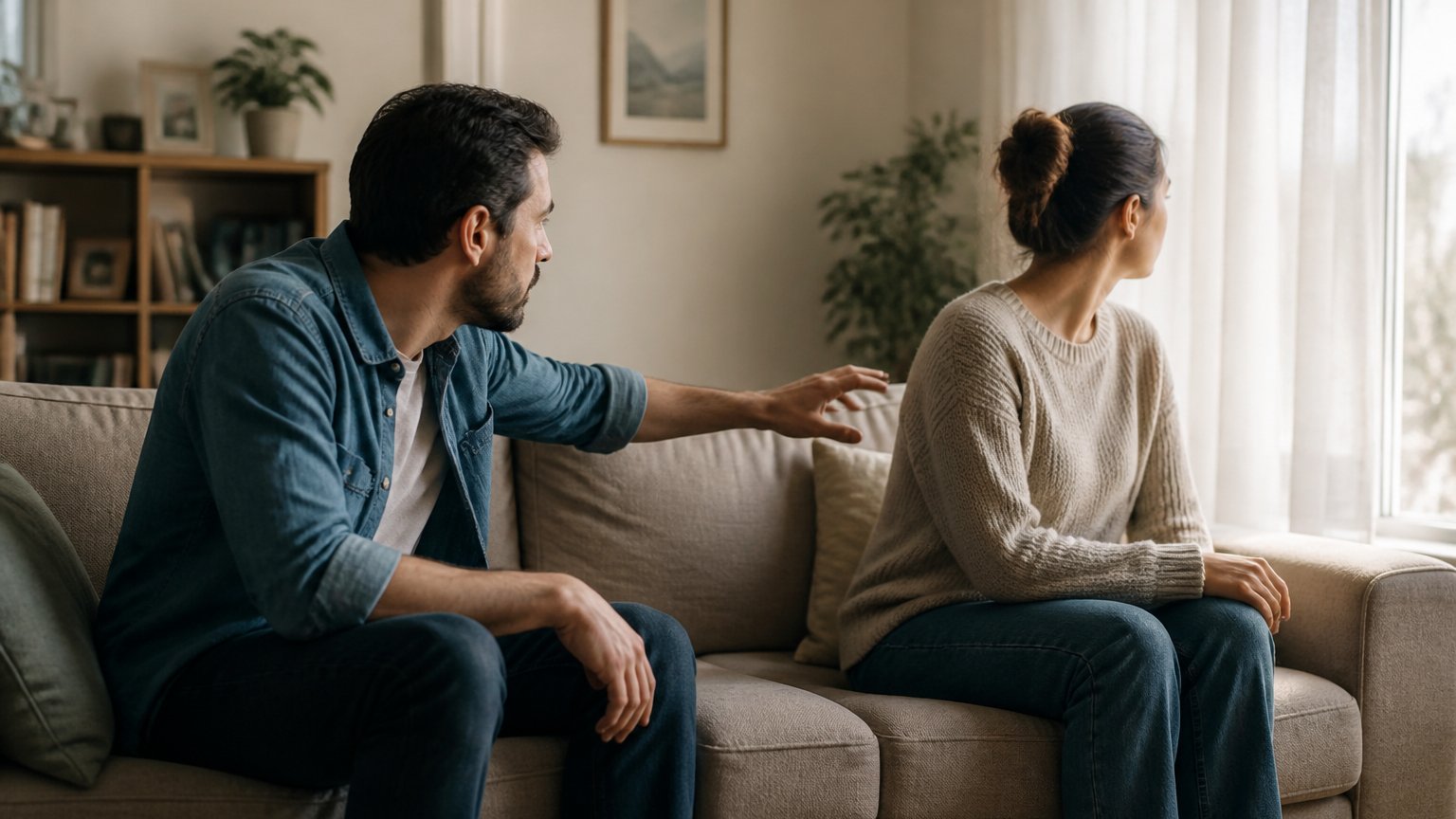
What does the anxious partner feel inside the loop?
From the anxious side, the experience is a near-constant hum of worry. There is hypervigilance to any shift in tone, a delayed text, a distracted look, a shorter goodnight than usual. Small signals get read as warnings that love is slipping away. The anxious partner often ends up feeling like they are "too much," apologizing for having needs at all.
What I have noticed is that this partner is not trying to control anyone. They are trying to close a gap that feels unbearable. When Maya calls for the third time, she is not being clingy for sport. Her nervous system is sounding an alarm that says the connection is in danger, and reaching out is the only thing that quiets it, at least for a moment. Trust me, from the inside this feels less like drama and more like survival.
What does the avoidant partner feel inside the loop?
The avoidant experience gets misread constantly, so I want to give it a fair hearing. This partner is not cold or indifferent. Underneath the calm surface, pursuit can feel like pressure, and pressure can feel like a threat to their sense of self. When closeness ramps up fast, they feel a strong urge to step back and self-regulate on their own, which is how they learned to feel safe.
The quiet story an avoidant partner often carries is "I am not enough" or "I will inevitably disappoint you, so I need room." When Sam goes silent, it is not punishment. It is an attempt to steady himself so he does not feel flooded. The heartbreak of avoidant anxious attachment is that the withdrawal meant to create safety is the exact move that terrifies the other person. Both are reaching for security using tools that cancel each other out.
Why does this dynamic feel so addictive?
Here is where things get interesting, and a little uncomfortable. The anxious avoidant attachment style in relationships can feel addictive, and there is a reason beyond willpower. The pattern runs on intermittent reinforcement, the same reward schedule that makes slot machines hard to walk away from.
When distance is followed by a warm reunion, the relief and reconnection light up the brain's reward system. The lows make the highs feel higher. So the relationship can feel thrilling precisely because it is unstable. I know that sounds intense, but many people describe their most "passionate" relationship as also their most painful, and this is often why. The great news is that once you recognize the mechanism, it loses some of its grip. You can start to tell the difference between real intimacy and an adrenaline loop.
How does the cycle escalate if nothing changes?
Left alone, the anxious and avoidant pattern rarely stays the same size. It tends to grow. The anxious partner's protests get louder because the old volume stopped working. The avoidant partner withdraws deeper because the pressure keeps climbing. Over months, both people accumulate a quiet stockpile of resentment and exhaustion.
This is where you see the classic on-again, off-again relationship: breakups followed by tearful reunions followed by the same fight. Each cycle erodes a little more trust. By the way, this is not a sign that the love was never real. It is a sign that the pattern is running the relationship instead of the two people. Naming that difference is genuinely hopeful, because a pattern can be changed even when it feels permanent.

What are the signs you are stuck in the anxious-avoidant trap?
Sometimes people are living inside this dynamic without a name for it. Here are the signals I point to most often. You do not need all of them for the pattern to be present.
- You swing between intense closeness and sudden distance, over and over.
- One of you consistently seeks reassurance while the other consistently needs space.
- The same argument about intimacy versus independence keeps reappearing in new clothes.
- One partner often feels abandoned; the other often feels smothered or criticized.
- Conflicts rarely resolve cleanly. They just cool off until the next flare-up.
- You feel addicted to the relationship even when it is making you unhappy.
If several of these ring true, take a breath. You are not alone in this, and recognizing the shape of the problem is the exact thing that makes it solvable.
Is "anxious-avoidant" the same as the childhood attachment style?
This is a fair point of confusion, so let me explain briefly. The phrase "anxious-avoidant" also names a category in child development. In the classic Strange Situation research with infants, an anxious-avoidant (or insecure-avoidant) baby shows little distress when a caregiver leaves and avoids them on return. That is a childhood classification about early caregiving, and it is a separate topic from the adult couple dynamic.
For our purposes here, we are focused on grown relationships, where anxious attachment and avoidant attachment belong to two different partners who then interact. It is also worth a quick note that pairings are not always one anxious and one avoidant. When two anxious attachment styles dating come together, for example, you get a different loop built on mutual reassurance-seeking and shared fear of loss rather than pursue-and-flee. The anxious-avoidant trap specifically describes the mismatch, and that mismatch is what gives it its distinctive push-pull rhythm.
How can couples break the anxious-avoidant cycle?
This is the part I love, because the pattern is far more workable than it feels in the heat of it. Breaking the cycle does not require becoming a different person. It requires learning a few new moves and practicing them when you are calm, not only when you are triggered.
Start by naming the cycle out loud as a shared enemy. Not "you are needy" or "you are cold," but "our pattern is doing the thing again." That single reframe turns two opponents into teammates facing a common problem. From there, a handful of skills do most of the heavy lifting:
- Self-regulation first. Each person learns to steady their own nervous system before reacting: a few slow breaths, a short walk, naming the feeling. The anxious partner soothes the alarm; the avoidant partner tolerates the discomfort without vanishing.
- Understand your triggers. Know what sets you off. For one it may be an unanswered message; for the other, a rapid-fire string of questions. Naming triggers ahead of time keeps them from hijacking the moment.
- Communicate the need under the behavior. The anxious partner can ask for reassurance directly instead of protesting. The avoidant partner can say "I need twenty minutes, and I am coming back" instead of going silent. That one sentence changes everything, because it signals distance without abandonment.
- Use structured breaks. Agree in advance that either person can pause a heated talk, with a real time to reconnect. A break with a return plan feels safe. A break with no plan feels like being left.
- Build small, consistent moments of security. Predictable check-ins, follow-through on little promises, and steady affection slowly teach both nervous systems that this bond is reliable.
Here is another way to look at it. Security is not a personality you are born with. It is something a couple can grow together with repetition. Many people move from an anxious or avoidant attachment style toward what researchers call earned security, and couples work such as emotionally focused therapy is designed for exactly this pattern. Change is slow and real, and every calmer cycle rewires the next one.
How can a relationship advisor help partners caught in the cycle?
When you are inside the anxious avoidant loop, it is genuinely hard to see it clearly. The fear talks louder than your perspective. This is where a caring outside voice can make a real difference, and it is one reason people reach out to a relationship advisor for a fresh read on their situation. A thoughtful couples psychic reading can offer a compassionate outside perspective on the patterns pulling you in different directions and help you reflect on what you actually need from love.
What I appreciate about that kind of conversation is the space it opens for self-growth. An advisor can help you notice where your own triggers fire, encourage you during a rough patch, and reflect back the dynamic you have been too close to see. Think of it this way: it is insight, perspective, and support for adults 18 and over, meant for guidance and self-reflection. A reading is not therapy and not a diagnosis, and it is not a replacement for working with a licensed couples counselor. Used alongside your own honest effort, though, that outside clarity can be a gentle nudge toward the security you are reaching for.
Questions I Get Asked Most
Can an anxious and avoidant couple actually work long term?
Yes, many do. The anxious avoidant attachment style is a pattern, not a life sentence, and the mismatch that fuels it can be softened. When both partners commit to self-regulation, name their triggers, and communicate the need under the behavior, the pursue-withdraw loop loses power. Couples who build small, consistent moments of safety often grow into what is called earned security. It takes patience and two willing people, but a lasting, calmer relationship is genuinely possible.
Why do I keep attracting avoidant partners?
If you lean anxious, avoidant partners can feel magnetic because the dynamic is familiar and the on-and-off rhythm creates intense highs. Your nervous system may register the uncertainty as chemistry. Recognizing that pull is the first step. As you build more security within yourself and learn to spot the pattern early, you tend to feel less drawn to unavailable partners and more comfortable with steady, reliable connection, which can feel unfamiliar at first but becomes deeply satisfying.
Is the avoidant partner the problem in the relationship?
No. Blaming one person misses how the cycle works. The avoidant partner withdraws to feel safe, just as the anxious partner pursues to feel safe. Both are coping strategies formed long ago, and each one triggers the other. Framing it as one person's fault usually deepens the loop. The more useful move is to treat the pattern itself as the shared problem you are both solving together, which turns opponents back into teammates.
What is the difference between the child and adult meaning of anxious-avoidant?
They are related ideas at different life stages. In child psychology, anxious-avoidant describes an infant who shows little distress at separation and avoids the caregiver on return, a classification from early attachment research. In adult relationships, anxious-avoidant usually names a couple dynamic where one partner is anxious and the other avoidant, producing the pursue-withdraw cycle. This article focuses on the adult version, which is about how two partners interact rather than a single person's early attachment.
Where does this leave you?
Here's what matters most: the anxious-avoidant trap is a loop between two frightened, well-meaning people, not proof that either of you is unlovable. Once you can see the pursue-withdraw cycle for what it is, you can step out of your assigned role and try a new move. Regulate first, name the pattern as your shared challenge, ask for what you need without protest or silence, and build tiny moments of reliable connection. Security is something you grow, not something you were denied for good. Be gentle with yourself and your partner, and give the new pattern time to take root.
